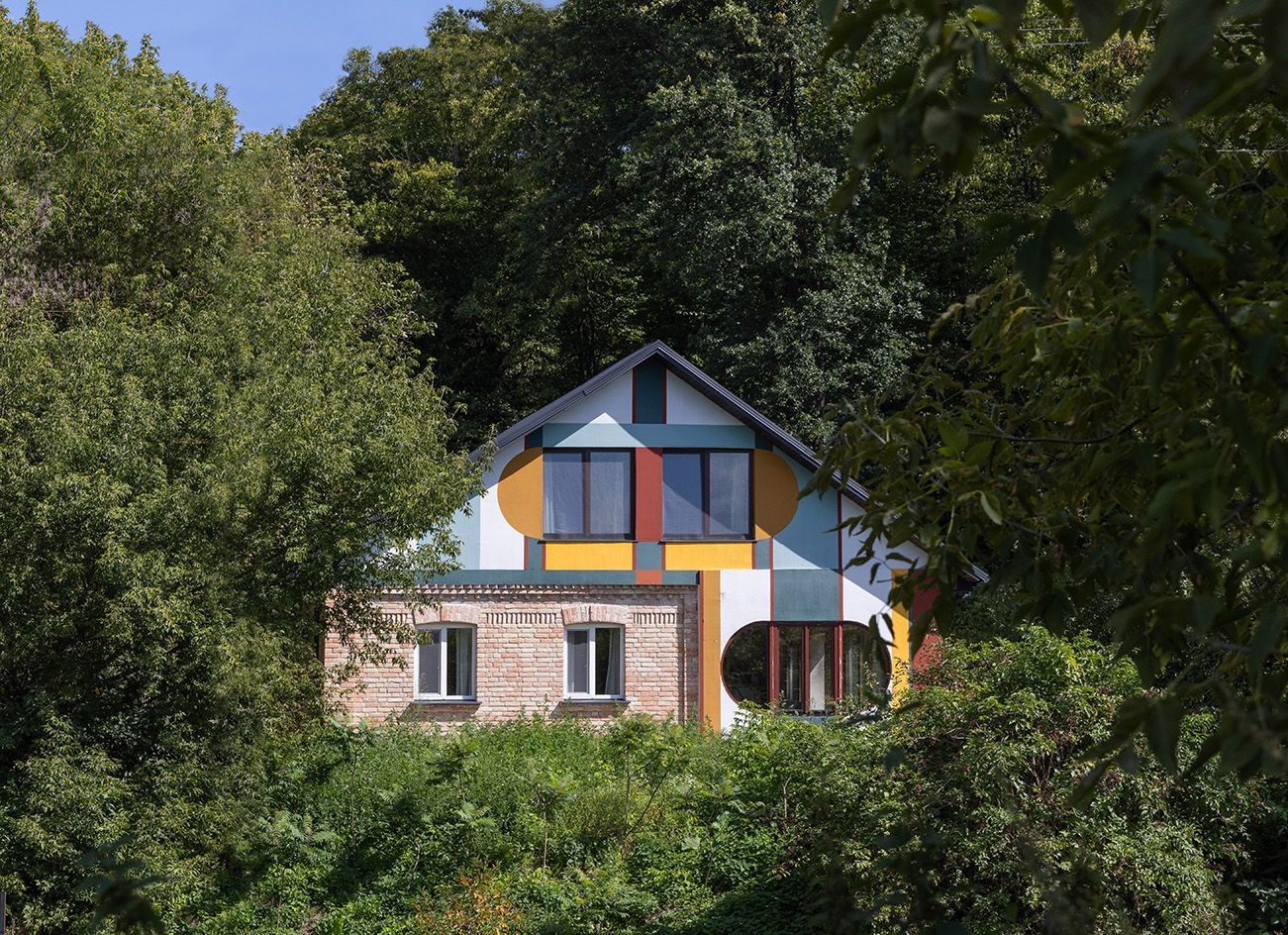
Artist Oksana Levchenya is transforming three neighboring Soviet-era homes in the village of Derev’yana, near Kyiv, into a series of guesthouses. The first completed home, known as Hata Yarova, features a striking facade mural inspired by Ukrainian modernism and Suprematism. Levchenya refers to her building technique as “intuitive additive architecture,” relying on small improvisational interventions and salvaged materials rather than a rigid plan.
The renovation utilizes a variety of repurposed elements. The original porch’s timber planks were turned into an interior staircase, while an extension was added to house a kitchen and bathroom. Oversized arched windows from a private midcentury house renovation were trimmed to fit the scale of the building, and outdoor decking was crafted from a timber platform originating at the former Kosmos factory. The bathroom incorporates a mix of 1960s and 1970s unglazed tiles, rare hand-painted tiles from Kharkiv, and contemporary Spanish ceramics.
Although the project originally began during the pandemic, the Russian invasion of Ukraine in 2022 gave the endeavor a profound new purpose. Levchenya views continuing construction during wartime as an act of defiance against destruction. By renting out the finished guesthouses, she covers project costs, keeps her small construction crew employed—led by a builder approaching his seventies—and provides a peaceful sanctuary for Ukrainians who have remained in the country.
Levchenya’s background heavily influenced the project. Growing up amidst parental divorce and frequent relocations across various family members’ homes and a cramped Khrushchyovka apartment, she long yearned for a permanent space. This history informs Hata Yarova’s aim to create an environment detached from a specific timeline.
A central anchor of the interior is an antique wooden chest from the 1930s, dating back to the period of Soviet collectivization. The object serves as a direct link to her family history of displacement. Having lost inherited possessions and homes multiple times—first following the 1917 revolution, again in the 1930s, and most recently when her family members lost their homes in Krasnopillia during the current war—Levchenya’s family prioritizes enduring human skills, knowledge, and memories over material items.
Levchenya also incorporates textiles, which she calls a “matriarchal medium,” connecting generations of women. Her artistic practice blends local folk traditions, Ukrainian modernism, and contemporary icons like Pac-Man. The house features a white totem constructed from knitwear factory offcuts and hand-woven kilims from OLK Manufactory, a Kyiv company founded by Levchenya that produces sustainable rugs using Carpathian sheep wool, nettle yarn, and hemp warps on vertical looms.
Ultimately, Levchenya hopes to expand the project internationally in the future, but her immediate focus remains on survival and winning the war.