
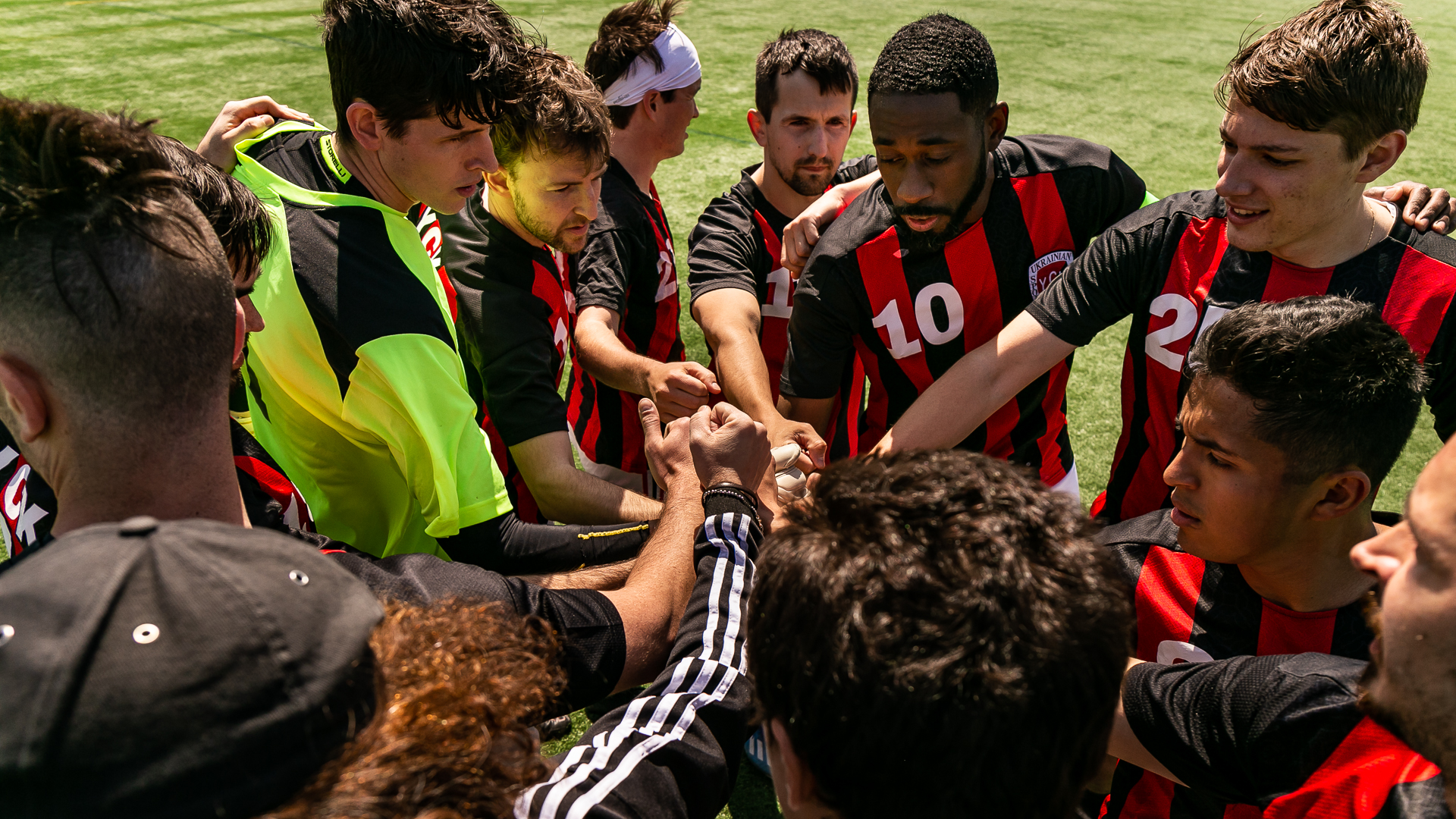
Founded in 1947 by Ukrainian migrants and refugees fleeing Soviet oppression and World War II, the Ukrainian Sports Club (YCK)—competing as NY Ukrainians in the historic Cosmopolitan Soccer League—continues to serve as a vital community anchor and support network for generations of immigrants in the New York City area.
Today, while few of the first-team players have direct Ukrainian heritage, the club maintains its cultural identity through its alumni, long-time traditions, and deep emotional resonance. As Russian troops continue their bombardment of Ukraine, members and players are heavily impacted, balancing daily anxiety about family and friends back home with local relief efforts. Board member and former player Iurii Vovk, along with other club affiliates, has actively fundraised for humanitarian organizations like Razom, which delivers food, supplies, and aid to Ukraine. On the pitch, players express solidarity through pre-match rituals, such as posing with the Ukrainian flag alongside opponents, fostering a strong sense of camaraderie and empathy during a turbulent time.
The team’s current season—culminating in a major second-division playoff match on Randall’s Island for a chance at promotion to the league’s top flight—reflects a legacy of resilience. Historically, the club established a prominent East Village headquarters in 1976 that served as a cultural hub for poetry readings, youth events, and international soccer broadcasts before the team transitioned to playing across various city parks.
The NY Ukrainians operate within the Cosmopolitan Soccer League, a nearly century-old amateur competition established in 1923 that mirrors the shifting demographics and waves of global conflict in New York City. Throughout its history, the league has incorporated clubs formed in response to political upheaval and foreign conflicts—such as Hungarian teams following the 1956 uprising and the New York Pancyprian Freedoms following the 1974 Turkish invasion of Cyprus. Through these localized athletic clubs, soccer functions as a universal language and a vehicle for community, unity, and shared identity among diverse immigrant populations across the New York metropolitan area.