
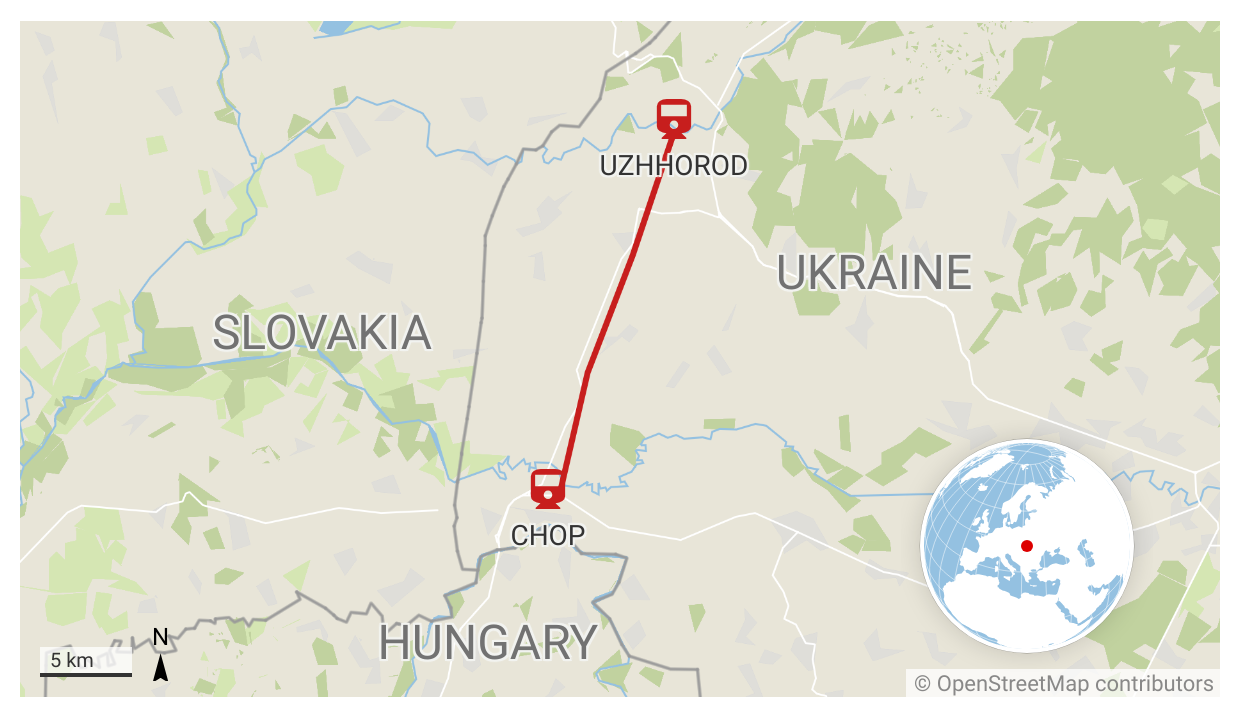
Ukraine has completed its first 22-kilometer European-gauge railway connecting Uzhhorod and Chop, marking a significant move away from Soviet-era rail infrastructure toward European standards. Scheduled to begin direct passenger operations to Vienna, Budapest, and Bratislava on September 12, 2025, the project eliminates time-consuming border train changes and establishes the first direct link between a Ukrainian regional capital and EU markets.
The €28.6 million project was funded equally through a European Investment Bank loan and an EU Connecting Europe Facility (CEF) grant, and was finished in under twelve months, months ahead of its 2026 schedule, despite wartime conditions. Workers installed 60,000 concrete sleepers, 4,000 tons of rails, 69,600 cubic meters of ballast, and modern microprocessor-controlled signaling systems. Notably, the project cost less than €30 million, contrasting favorably with typical EU railway construction costs ranging from €12 million to €45 million per kilometer.
This rapid progress contrasts with projects like the Baltic States’ Rail Baltica, which has experienced long delays and cost overruns since launching in 2014. While the Baltic nations retained Russian-gauge tracks after joining the EU and NATO, Ukraine views infrastructure conversion as a vital component of its survival, economic support, and European integration.
The initiative forms part of the extended Trans-European Transport Network (TEN-T) corridors within Ukraine. The European Commission has allocated €110 million in non-reimbursable support under the Connecting Europe Facility to integrate Ukrainian and EU rail systems, including a recent July grant of €76 million designated for a standard-gauge line from the Polish border to Lviv.
Ukrainian Railways (Ukrzaliznytsia) plans to electrify the current section in 2026 and begin the extension toward Lviv, aiming for completion within two to three years. Further expansions are planned for Zakarpattia and Volyn oblasts, creating comprehensive freight and passenger corridors to the Czech Republic, Hungary, Poland, and broader European markets. Officials and international leaders emphasize that this infrastructure development under fire demonstrates Ukraine’s delivery capacity and accelerates traditional EU integration timelines, proving that critical structural alignment does not need to wait for a stable post-war period.