
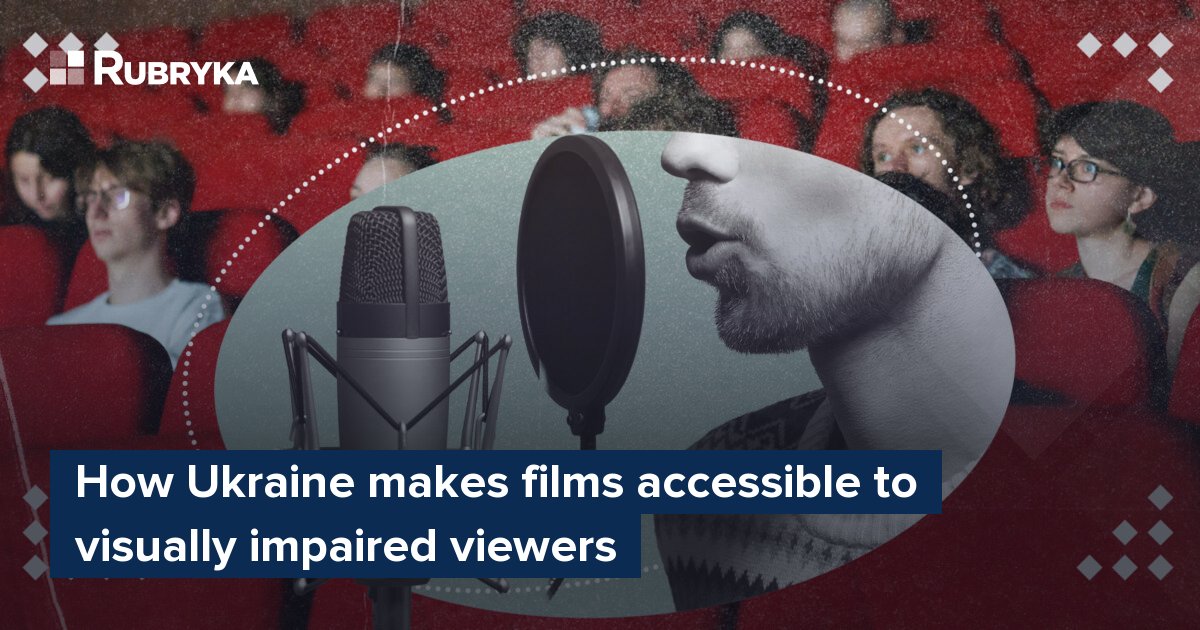
As the number of people with vision loss in Ukraine has grown—rising to over 160,000 diagnosed cases by April 2026 due to factors including the war—access to culture and cinema has become a pressing issue. Because Ukraine lacks a unified national standard for film accessibility, the industry and cultural organizations are stepping in to create audio descriptions for visually impaired viewers. Government initiatives are also emerging, such as Law No. 4743-IX, signed by President Volodymyr Zelenskyi in June 2026, which mandates audio descriptions for films receiving state funding.
Organizations like the Docudays UA International Human Rights Documentary Film Festival lead the effort to adapt films. The production process involves several meticulous steps. First, the festival selects films, prioritizing Ukrainian productions so that the resulting audio descriptions can later be used during nationwide theatrical releases. Next, writers analyze the film, study dialogue lists, and map out pauses where descriptions can fit without overlapping with dialogue or music.
Audio-description scripts follow strict guidelines: information is delivered in a specific order (who, what, where, when, and how), subjective interpretations of character emotions are strictly avoided to prevent writer bias, and language must be clear and direct. Once written, the scripts are edited, proofread, and tested by focus groups of blind viewers who provide immediate feedback. Afterward, the descriptions are recorded by human narrators—often maintaining a neutral, steady delivery—and synchronized using smartphone apps like MovieReading, which use the film’s soundtrack to align the audio description in real time.
Despite these advancements, significant barriers remain. While major film festivals and cinematic releases increasingly offer audio descriptions, streaming platforms like Netflix lag behind in providing Ukrainian audio tracks. Furthermore, experts point to a lack of uniform national guidelines for writers, inconsistent quality control, and the overuse of monotonous AI-generated voices that struggle with correct pacing and intonation.
To address navigation and availability, projects like the 03:00 Foundation’s “Voiceover” initiative have launched free catalogs consolidating hundreds of audio-described films with direct links to streaming platforms. Meanwhile, regulatory bodies like the State Film Agency are working to update rules so that state-supported film budgets officially incorporate the costs of accessible formats from the very beginning of production.